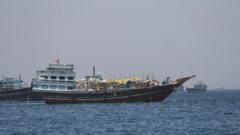
The steel plates of a VLCC tanker are thick enough to stop a bullet, but they cannot keep out the heat of a Persian Gulf summer. On the deck of a marooned vessel just outside the Strait of Hormuz, the air is not a gas; it is a weight. It carries the scent of salt, heavy fuel oil, and the sharp, metallic tang of stagnant fear.
For the twenty thousand seafarers trapped in this liquid purgatory, the horizon has become a prison wall.
These men—mostly from the Philippines, India, and Ukraine—did not sign up for a war. They signed up for six-month hitches to send money home to Manila or Mumbai. They are the invisible connective tissue of our global life. When you click "buy" on a screen in Chicago or light a stove in Berlin, you are relying on these men to navigate the world’s most dangerous needle-eye.
Right now, they are running out of water. They are eating their final rations of rice. And for the last several months, they have watched the sky with a specific, neck-craning dread, waiting for the buzz of a drone or the white streak of a missile that doesn't care about their neutrality.
The Geography of a Chokehold
To understand why the world is currently holding its breath, you have to look at the map. The Strait of Hormuz is only twenty-one miles wide at its narrowest point. Imagine a highway where twenty percent of the world’s energy flows through a single lane. Now imagine that lane is littered with unmapped mines and flanked by hostile batteries.
It is a masterpiece of geopolitical leverage. By tightening their grip on this passage, Iran didn't just stop ships; they stopped the pulse of global commerce. One-fifth of the world’s oil and nearly a third of its liquefied natural gas are essentially held hostage.
While the high-level diplomats in temperature-controlled rooms in Tehran and Washington trade barbs about nuclear programs and ceasefire breaches, the reality on the water is far more visceral. Shipping companies are facing a binary choice: pay "coordination fees" to a sanctioned regime—thereby risking the wrath of the U.S. Treasury—or let their billion-dollar assets sit and rot in the sun.
Most chose to wait. The result is a ghost fleet of over a thousand commercial vessels, bobbing in the swells, their crews caught in a game of high-stakes chicken they never asked to play.
The Dawn of Project Freedom
On Sunday, a new variable entered the equation. It didn't come in the form of a diplomatic cable, but a digital decree from the Florida shoreline.
The initiative is called Project Freedom. The premise is deceptively simple: the United States military will no longer watch from the sidelines while "neutral and innocent" ships are squeezed by a maritime blockade. Starting Monday morning, the U.S. Navy began a massive logistical "guidance" operation to extract these stranded mariners.
It is a move of characteristic audacity. By labeling this a "humanitarian mission," the administration is attempting to bypass the traditional escalatory ladder of naval warfare. They aren't just sending ships; they are sending a clear message that the status quo—where 20,000 sailors are used as bargaining chips—is over.
The sheer scale of the mobilization is staggering. We are talking about guided-missile destroyers acting as steel shields, backed by over a hundred aircraft and 15,000 service members. This isn't just a patrol; it’s an armored corridor carved through a minefield.
The Human Cost of High Prices
It is easy to get lost in the numbers—the 100 aircraft or the $106 per barrel price of Brent crude. But the real story is found in the smaller, quieter tragedies.
Consider a hypothetical third officer named Aris. He hasn't seen his daughter in nine months. His ship has been anchored for twelve weeks. Every time a U.S. or Israeli strike hits a target in the distance, the vibration travels through the water and hums in the hull of his ship, a low-frequency reminder that he is sitting on millions of gallons of highly flammable cargo.
He is one of the victims of circumstance the President mentioned. These are the people for whom the term "freedom of navigation" isn't a legal abstraction—it’s the difference between going home and becoming collateral damage.
The global economy feels this friction in a different way. When the Strait closes, the price of fertilizer in Pakistan skyrockets. When the price of fertilizer skyrockets, the cost of bread in a village thousands of miles away follows. This is the "tipping point" traders have been warning about. We are all connected to the Strait of Hormuz by a thousand invisible threads of supply and demand.
A High-Stakes Gamble
There is, of course, a profound risk. Iran has already signaled that any U.S. movement into these "restricted" waters will be viewed as a breach of the standing ceasefire. Their military commanders aren't talking about humanitarian aid; they are talking about targets.
The tension is a physical thing. On Monday, reports began to surface of a tanker being struck by projectiles north of Fujairah. Shortly after, the U.S. Central Command confirmed that the first American-flagged vessels had already completed their escorted transits.
It is a masterclass in brinkmanship. By moving the first ships through, the U.S. is forcing Iran to decide: do they truly want to fire on a humanitarian convoy and risk a full-scale return to war, or do they allow their "chokehold" to be loosened?
The U.S. isn't just betting on its naval might; it is betting on the idea that the world is tired of the disruption. They are inviting an international coalition to join what they call the Maritime Freedom Construct. It’s an attempt to turn a unilateral American move into a global mandate.
The Silent Return
If Project Freedom succeeds, you won't see a victory parade. Instead, you will see a slow, steady stream of rust-streaked tankers finally moving toward the open ocean. You will see 20,000 men calling their families to say they are finally coming home.
But the mines remain. The missiles are still aimed. And the "positive discussions" mentioned between Washington and Tehran are still shrouded in the fog of a war that hasn't quite ended.
We are watching a live experiment in power. Can a superpower re-open a closed vein of the world through sheer force of will and a humanitarian label? Or is the Strait of Hormuz a trap that once closed, can never truly be pried open without a much larger, much darker price?
As the first destroyers cut their wakes through the turquoise waters of the Gulf, the answer is still drifting somewhere in the heat haze. The ships are moving, but the world is still waiting to see if they make it to the other side.
Trump's Project Freedom shipping mission
This video provides a direct overview of the President's announcement regarding the start of Project Freedom and the maritime security situation in the Strait of Hormuz.


