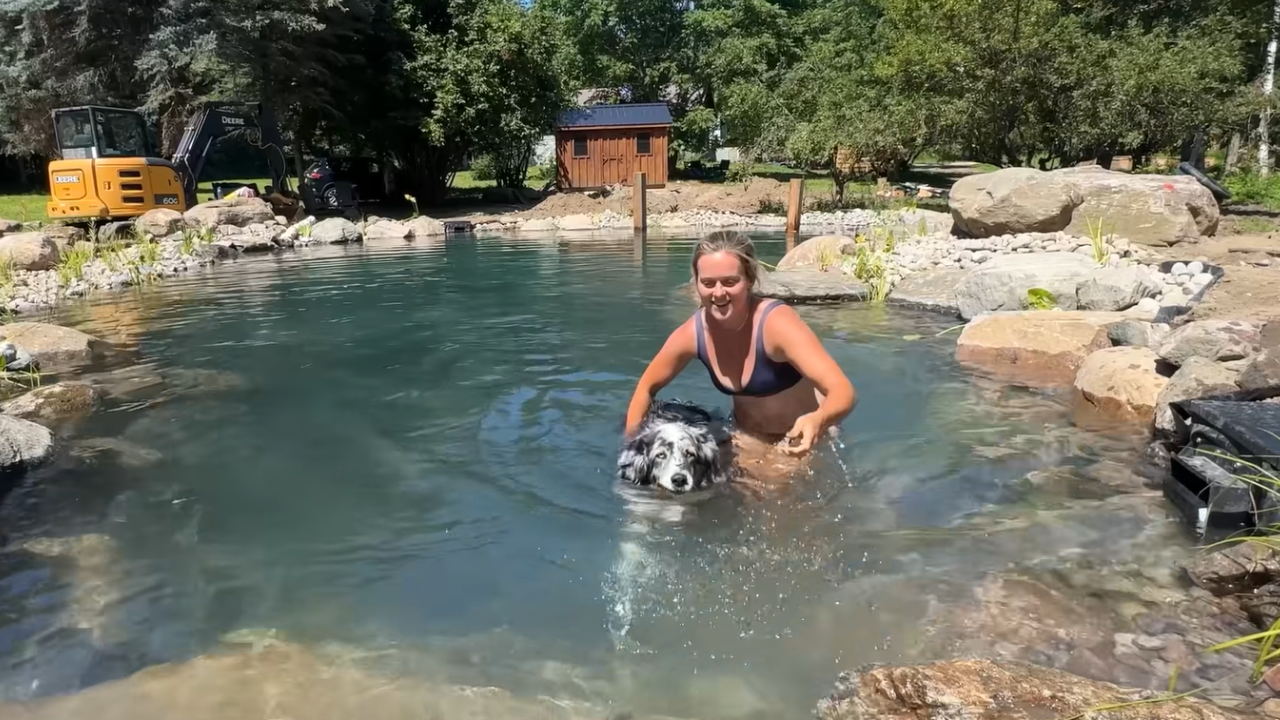
When Crystal Drinkwalter and Jazmyn Canning spent $52,000 to build a natural swimming pond on their 65-acre property, the headlines celebrated a massive $148,000 savings over commercial quotes. While the viral story proves that owner-builders can bypass exorbitant contractor markups through heavy labor and direct sourcing, that six-figure savings figure obscures a much more complicated financial and ecological reality. Building a chemical-free, biologically filtered swimming hole requires trading upfront capital for intense physical sweat, navigating strict environmental permitting, and assuming perpetual maintenance liabilities that commercial builders usually price into their high bids.
The viral narrative relies on a simple, seductive math equation. A commercial luxury pond builder quotes $200,000 for a turn-key natural swimming pool. Two determined landowners rent an excavator, buy raw materials directly from quarries, hire a local operator for the technical grading, and finish the project for $52,000. On paper, they just pocketed $148,000.
In the excavation and water-feature industry, we call this sweat-equity arbitrage. It works, provided you actually own the dirt and possess the time to manage a complex civil engineering project. Yet when urban and suburban homeowners read these stories, they rarely account for the massive structural advantages of a 65-acre rural parcel.
The Anatomy of Contractor Markups
To understand how Drinkwalter and Canning shaved nearly seventy-five percent off the industry standard, you have to look at how commercial water-feature companies bill. When a specialized firm quotes $200,000 for a natural swimming pond, you are not paying $200,000 for gravel, rubber liners, and pumps.
Materials typically account for only twenty-five to thirty percent of a commercial build. The rest is absorbed by overhead, specialized insurance, mobilization fees for heavy machinery, warranty reserves, and labor margins. Natural swimming ponds are notoriously finicky. If a biological filter fails or a liner develops a pinhole leak six months after completion, the contractor is legally and reputationally on the hook to drain the basin, pull out tons of river rock, and fix it on their own dime. They price that catastrophic risk into every bid.
By acting as their own general contractors, Drinkwalter and Canning stripped out the risk premium. They absorbed the liability themselves. If a seam leaks or an algae bloom turns the water into pea soup next July, there is no contractor to call.
Why 65 Acres Changes the Math
Location dictates feasibility. Moving fifty tons of boulders and hundreds of yards of subsoil on a 65-acre spread is an entirely different logistical exercise than doing the same work on a half-acre suburban lot.
On large acreage, you rarely pay to haul away excavated dirt. You simply grade it into a berm, use it to level a pasture, or build up the banks of the pond itself. For a typical homeowner, dirt removal alone can add $10,000 to $20,000 in trucking and tipping fees. Furthermore, rural properties often feature native clay soils that either hold water naturally or provide a smooth, rock-free base for synthetic liners, reducing the need for expensive geotextile underlayment and imported sand.
Access is the other hidden cost driver. A full-sized excavator and tandem dump trucks can maneuver freely across open fields. In a standard residential neighborhood, contractors must use smaller, slower mini-excavators, lay down protective plywood over driveways, and carefully work around buried utility lines, septic fields, and property setbacks. Those constraints double the labor hours before a single gallon of water enters the basin.
How Biological Filtration Actually Works
A natural swimming pond is not a stagnant farm pond, nor is it a standard swimming pool with rocks glued to the edges. It is an engineered wetland designed to mimic the self-cleaning mechanics of a mountain lake.
The system relies on dividing the water body into two distinct zones: a deep swimming zone and a shallow regeneration zone.
In a properly balanced build, the regeneration zone makes up roughly forty to fifty percent of the total surface area. This shallow shelf is packed with specific strata of washed gravel—usually ranging from coarse stone at the bottom to pea gravel at the top—and planted heavily with aquatic macrophytes like rushes, sedges, water lilies, and hornwort.
Water is continuously circulated from the deep swimming area through this gravel bed using low-wattage, high-efficiency pumps. As the water moves through the substrate, two things happen simultaneously:
- Mechanical trapping captures fine suspended solids and organic debris.
- Biological nitrification occurs as beneficial bacteria colonizing the vast surface area of the gravel consume dissolved nutrients, primarily phosphates and nitrates.
Without those excess nutrients in the water column, single-celled planktonic algae—the culprit behind murky green water—starve to death. The plants in the regeneration zone then absorb the processed nutrients to fuel their own growth, locking them out of the water cycle until you harvest and trim the foliage in the autumn.
The Hidden Liabilities of the DIY Route
The $52,000 price tag covers the initial construction phase, which is where most viral articles stop counting. Veterans of the pond industry know that the real test of a natural swimming pool begins in year two and year three.
The Phosphorus Trap
The single biggest mistake owner-builders make to save money is skipping the specialized aggregate washing process or sourcing the wrong type of rock. Quarried limestone, for example, is cheap and widely available, making it a tempting choice for a budget build. It is also loaded with bound phosphorus and raises water pH, creating a chemical paradise for stubborn string algae.
Even with inert granite or river rock, failing to thoroughly power-wash the stone before installation introduces tons of fine silt and nutrient-rich dust directly into the regeneration zone. Once that silt settles at the bottom of a four-foot gravel bed, it becomes an anaerobic nutrient bomb. Cleaning it out requires excavating the entire wetland filter by hand—a grueling, multi-week nightmare that makes a $148,000 contractor quote look remarkably reasonable.
Water Loss and Liner Vulnerabilities
Unless a property sits on a high water table with heavy, unfractured blue clay, a natural swimming pond requires a continuous waterproof membrane. High-grade EPDM rubber or reinforced polyethylene (RPE) liners are the industry standards, and they represent one of the largest single line-item expenses in a build.
To keep costs near $52,000 on a large pond, builders have zero margin for error during liner installation. A single sharp root, an overlooked angular stone beneath the protective underlayment, or an improperly primed seam tape can cause a slow leak. Losing just half an inch of water a day across a 3,000-square-foot surface equates to nearly 1,000 gallons of lost water every twenty-four hours. Finding a pinhole leak under forty tons of submerged gravel is akin to finding a needle in a haystack while wearing scuba gear.
Regulatory Hurdles Nobody Puts in Headlines
When you dig a massive hole and fill it with tens of thousands of gallons of water, local governments take notice. A commercial contractor handles the bureaucratic labyrinth as part of their fee. A DIY builder faces the municipal code enforcement office alone.
In most jurisdictions across North America, any body of water deeper than twenty-four inches is legally classified as a swimming pool, regardless of whether you put frogs and lilies in it. That classification triggers strict barrier and fencing laws. You may be legally required to surround your idyllic, rustic pond with a four-foot-high, self-closing, self-latching fence—an expense that can easily run $8,000 to $15,000 and completely ruin the seamless natural aesthetic you wanted in the first place.
Environmental and water-rights laws present an even steeper wall. If your property contains seasonal wetlands, sits near a natural creek, or falls within a protected watershed, digging a basin can violate federal or state clean water statutes. Diverting surface runoff or pumping groundwater from a well to fill a 100,000-gallon pond is strictly regulated in drought-prone regions. Ignorance of these codes does not shield landowners from fines, and municipal authorities have the legal power to force you to fill an unpermitted pond back in at your own expense.
Calculating the True Cost of Ownership
If you are considering replicating Drinkwalter and Canning’s blueprint, you have to evaluate the project across a ten-year horizon rather than looking solely at the construction receipts. A realistic budget for a substantial owner-built natural pond must account for ongoing operational realities.
| Expense Category | Commercial Turn-Key Build | Owner-Builder DIY Route |
|---|---|---|
| Upfront Capital | $150,000 – $250,000+ | $45,000 – $75,000 |
| Labor Input | Zero (Managed by firm) | 300 – 600+ personal hours |
| Equipment Rental | Absorbed in bid | $5,000 – $12,000 |
| Electrical & Pumps | $40 – $80 / month | $40 – $80 / month |
| Annual Maintenance | $2,500 – $5,000 (Service contract) | $300 – $600 (Supplies + personal labor) |
| Leak/Failure Liability | Covered by builder warranty | 100% out-of-pocket |
Let us look at a hypothetical example to see how the labor math breaks down. Suppose you save $120,000 by managing the build yourself, sourcing your own stone, hand-laying the underlayment, seaming the liner, plumbing the skimmers, and planting 800 aquatic plugs. If you invest 500 hours of your own physical labor into the excavation, rock placement, and landscape grading, you have effectively paid yourself $240 an hour—tax-free. For someone with physical stamina, basic mechanical aptitude, and flexible time, that is an extraordinary return on effort.
Conversely, if you have to take unpaid leave from a high-earning career, rent machinery multiple times due to weather delays, and pay for costly mistakes like cracked PVC manifolds or torn liners, that $120,000 savings evaporates rapidly.
The Routine Maintenance Reality
A natural pond is not maintenance-free; it is simply chemical-free. Instead of testing chlorine levels and dumping shock into the water every Saturday, you become a part-time aquatic farmer.
Every spring, before water temperatures climb above fifty-five degrees, you must vacuum the organic sludge—decaying leaves, windblown pollen, and dead algae—off the bottom of the swimming zone. If you leave that organic matter on the floor, it decomposes and feeds summer algae blooms. Every autumn, you must wade into cold water to cut back all the dead stalks of your rushes and lilies before they collapse into the pond and rot over the winter. You also have to skim falling leaves daily during October and November, or stretch an unsightly mesh net over the entire surface.
How to Audit Your Property Before Digging
Before renting an excavator or ordering a single yard of gravel, run your land through a strict feasibility audit. If your property fails any of these baseline tests, a DIY natural pond will likely become a financial sinkhole.
- Test the water source. Have your well or municipal water tested for phosphates, nitrates, iron, and total hardness. Filling a natural pond with high-phosphate well water guarantees a massive, uncontrollable algae bloom from day one.
- Check the water table and soil composition. Dig a test pit to your desired maximum depth—ideally seven to eight feet for a swimming zone—and leave it open for a week. If groundwater seeps into the hole, installing a synthetic liner becomes vastly more complex because hydrostatic pressure from below can float the liner like a giant bubble whenever the pond level drops.
- Map the sun exposure. Full, unrelenting sun heats shallow regeneration zones rapidly, accelerating evaporation and algae growth. Aim for a site that receives at least four to six hours of shade during the peak afternoon heat, while keeping large deciduous trees far enough away that their root systems do not threaten the liner and their leaves do not overwhelm your skimmers.
- Verify utility and septic clearances. A leaking pond or an overflow spillway draining toward a septic leach field will saturate the soil and cause catastrophic septic failure. Keep the basin downslope and well away from all wastewater infrastructure.
Crystal Drinkwalter and Jazmyn Canning proved that with enough acreage, grit, and smart sourcing, landowners do not have to pay luxury resort prices to build a stunning swimming hole. Just remember that the $148,000 they saved was never really free—they simply chose to pay for their pond with calluses, diesel fuel, and endless weekends of physical labor instead of writing a check.