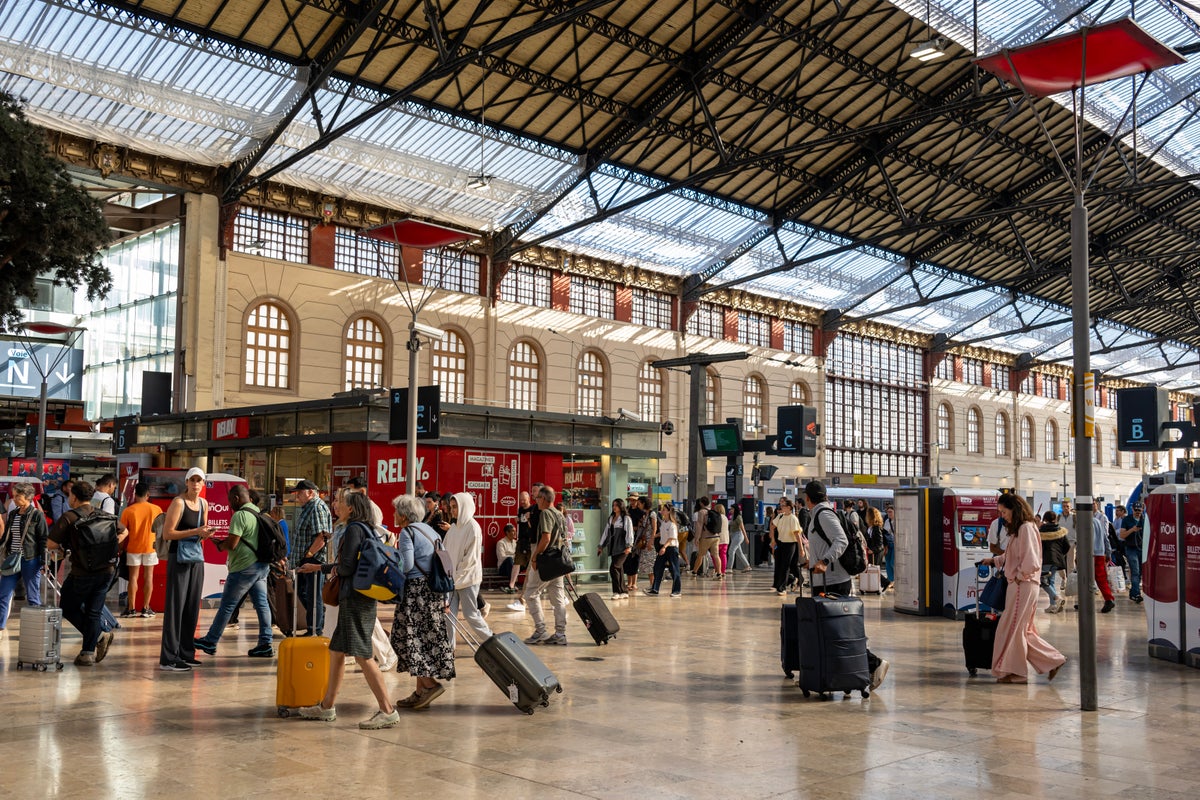
The air inside the station does not move. It sits on your chest, thick with the smell of scorched brake pads, old grease, and the collective exhaust of five thousand damp human bodies trying to escape the city. On a normal Tuesday, the underground platform is just a transition space—a subterranean pipeline meant to swallow you up and spit you out closer to home. But when the mercury hits triple digits, the architecture turns hostile.
You can feel the heat radiating off the tiles. It creeps through the soles of your shoes.
Up on the concourse, the digital departure boards are bleeding red. Delay. Delay. Cancellation. A voice cracks over the public address system, thin and metallic, delivering a message that sounds less like a corporate update and more like a tactical retreat. The rail network is buckling. And if you are frail, if you are old, if your body relies on medical precision to keep its internal thermostat from failing, the chief executive of the railway has a direct piece of advice for you:
Stay away. Do not get on the train.
It is a strange moment in modern logistics when a mass transit provider begs its customers to stop using its services. We are conditioned to believe in the absolute resilience of steel and concrete. We assume that infrastructure is permanent, that iron is tougher than flesh. But a record-breaking heatwave exposes the fragile truth of our interconnected world. Under the blistering sun, the multi-billion-dollar network we take for granted becomes shockingly vulnerable. And the human cost of keeping it running falls squarely on those who can least afford to bear it.
The Point Where Steel Remembers It Was Liquid
To understand why a railway boss would issue such a stark warning, you have to look at the track itself.
Consider a hypothetical stretch of standard rail line—let us call it Route 9. In the cool dampness of a regular spring morning, that steel track is perfectly straight, locked into place by heavy concrete sleepers and tons of crushed stone ballast. It looks indestructible. But steel is a living material. It breathes. It expands when it gets hot and contracts when it freezes.
When engineers lay down track, they perform a delicate piece of mathematics. They calculate the Stress-Free Temperature (SFT). This is the specific temperature at which the rail is under no thermal stress at all—neither pulling itself apart from the cold nor crushing itself from the heat. In temperate regions, this sweet spot is usually set around 81°F (27°C).
But the sun is a brutal radiator. On a day when the air temperature hits 100°F, the dark metal of the rail absorbs the solar energy until the steel itself cooks at 120°F or higher.
What happens next is pure physics. The steel expands. It wants to grow longer, but it is pinned down by thousands of clips and buried in stone. The energy has nowhere to go. The pressure builds within the metal, a silent, mounting fury, until the rail reaches its breaking point.
Then comes the buckle.
With a sound like a gunshot, the track twists. It warps into an S-shape, ripping itself away from the ties. If a commuter train hitting 90 miles per hour encounters that sudden curve, the result is catastrophic. To prevent this, rail operators do the only thing they can: they order the trains to slow down. A slower train exerts less dynamic force on the fragile rails, reducing the risk of a derailment.
But slowness breeds its own disaster.
The Greenhouse on Wheels
When you drop the speed of a commuter network by half, the schedules collapse like a house of cards. Trains stack up behind one another. A journey that normally takes forty minutes stretches into three hours.
And that is when the real danger shifts from the infrastructure to the passenger.
Imagine an elderly woman named Margaret. She is seventy-eight, living with a mild heart condition, and she needs to travel three stops down the line for a hospital appointment. She hears the warnings on the news, but the appointment took six months to book. She cannot miss it. She steps onto the platform, her breath catching in the stagnant, heavy air.
When the train finally rumbles into the station, it is already packed to the doors with passengers from two previous cancelled services. She squeezes inside.
The air conditioning on an old passenger carriage is not designed for extreme anomalies. It is built to handle average summers. When the car is stationary on a sun-baked piece of track for an hour, waiting for clearance from a delayed signal, the system chokes. The windows do not open. The body heat of two hundred panicked, sweating people turns the carriage into a terrarium.
Inside Margaret’s body, a quiet crisis begins.
The human heart is an elegant cooling pump. When you get hot, your brain signals your blood vessels to dilate, pushing blood away from your core and toward your skin, where the heat can radiate away. Your heart rate increases to keep this cooling cycle moving.
But Margaret’s heart is already tired. At 104°F inside the train car, her body is absorbing heat faster than it can reject it. Sweating drops her fluid levels, making her blood thicker, stickier, and harder to pump. Her blood pressure drops. She feels dizzy. The air feels thin.
This is not a theoretical scenario. This is the exact sequence of physiological failures that rail executives are terrified of triggering. When an operator tells vulnerable people to stay home, they are not being lazy. They are admitting a terrifying truth: if the grid locks up and a train stalls in the middle of a sun-scorched cutting, they cannot guarantee they can get emergency medical technicians to you before the heat does permanent damage.
The Fiction of the Modern Shield
We have spent the last century building a civilization designed to insulate us from the weather. We move from air-conditioned apartments to air-conditioned cars to air-conditioned offices. We have treated climate as a background setting, something to be adjusted with a thermostat.
This creates a dangerous illusion of safety.
We look at a massive locomotive, a 120-ton beast of engineering, and we assume it is immune to a hot afternoon. It feels impossible that a few degrees of extra warmth could paralyze a nation's transportation artery. But our systems are optimized for a world that is rapidly disappearing. They were built for the averages of the twentieth century, not the extremes of the twenty-first.
When those extremes hit, the margin for error vanishes.
The individual components of a transit system are deeply interdependent. If the overhead power lines sag because the copper has expanded in the heat, the train loses power. If the train loses power, the air conditioning dies. If the air conditioning dies, the passengers face heat exhaustion within twenty minutes. If a passenger collapses, the train must stop completely to wait for an ambulance, which further delays the ten trains trapped behind it on the warped track.
It is a cascade of failure that starts with a solar ray and ends with a medical emergency.
The Hard Choice on the Platform
So we return to the platform, where the air smells of static and sweat.
The warning from the railway chief is a placeholder for a much larger conversation we are avoiding. It is an acknowledgment that our collective engineering cannot out-muscle the changing physics of our environment without massive, radical reinvestment. Until we rebuild the world to withstand the new baseline, our only tool is retreat. We must ration our movement. We must tell the old, the pregnant, and the weak to hide indoors until the sky cools down.
Margaret stands on the edge of the yellow line. The train doors open, releasing a wave of humid, hot air that smells of crowded frustration. She looks at the tightly packed faces inside. She looks at the digital sign that has just revised her arrival time by another sixty minutes.
She takes a step backward.
The doors hiss shut, and the train crawls away into the dark tunnel, its wheels squealing against the stressed, groaning metal of the curves. Margaret turns toward the stairs, choosing the long, slow walk back up to the street. It is a minor defeat in a small daily battle, but it is the only sensible choice left when the machine we built to serve us can no longer guarantee our survival.