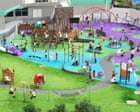
Walk into almost any local playground across Britain on a Saturday morning, and you'll spot the exact same problem within thirty seconds. Woodchips. Narrow ladders. Swings with zero back support. For hundreds of thousands of families raising disabled children, the neighborhood park isn't a place to unwind—it's a minefield of physical barriers and awkward stares.
That's why the arrival of purpose-built, £10m play centres for disabled children in the UK isn't just a nice charity headline. It's a massive shift in how we treat basic childhood rights. Parents are calling these spaces life-changing because, for the first time, their kids aren't being asked to adapt to a space built for someone else. The space was built for them from the concrete slab up.
Let's be honest about what usually passes for "inclusive play" in local council budgets. Slapping a single wheelchair-accessible swing onto the edge of a bark-mulch playground doesn't make a park inclusive. It isolates the disabled child at the perimeter while everyone else runs off to the main climbing frame. When a facility actually invests £10 million into dedicated infrastructure, the entire dynamic flips.
What £10m Actually Buys When Accessibility Comes First
You might wonder how a play centre costs ten million pounds. If you haven't priced specialized pediatric equipment or commercial-grade sensory architecture, that price tag sounds steep. It isn't.
Standard soft-play centres buy off-the-shelf foam tunnels and plastic slides. Purpose-built centres for children with complex disabilities require custom engineering from the ground up. We're talking about reinforced ceiling tracks for overhead hoists that run seamlessly from the car park right into the hydrotherapy pools and changing areas. We're talking about Changing Places toilets—not standard accessible stalls, which are far too small for older children who need full-sized adult changing benches and ceiling hoists.
Then there's the sensory engineering. Neurodivergent children, particularly those with severe autism or sensory processing disorders, can be completely overwhelmed by the echoing roar of a typical indoor play barn. High-end accessible centres use acoustic baffling in the ceilings, dimmable circadian lighting zones, and tactile walls that calm rather than overstimulate.
Here's what separates a genuine £10m accessible hub from a standard community centre with a wheelchair ramp:
- Full-building hoist networks so parents don't risk back injuries lifting growing teenagers out of wheelchairs onto play mats.
- Sunken trampolines and wheelchair-accessible roundabouts built flush with the floor, removing the lip that stops heavy powered chairs dead in their tracks.
- Dedicated quiet rooms adjacent to main play zones, giving children an immediate escape hatch if sensory overload hits.
- Trained play workers who understand complex medical needs, tube feeding, and non-verbal communication, meaning parents can actually sit down and drink a hot cup of coffee.
The Hidden Crisis Behind the "Life-Changing" Reaction
When parents describe these new UK centres as life-changing, they aren't exaggerating for the local press. To understand the relief, you have to look at the isolation families with disabled children face every single week.
According to research from UK disability charities like Scope and Sense, families raising disabled children experience drastically higher rates of social isolation and parental burnout than the general population. Simple weekend outings require military-grade logistics. Before leaving the house, a parent has to check if there's an accessible toilet with a hoist within twenty minutes of the venue. If there isn't, the trip is capped at two hours—or cancelled entirely.
Worse still is the social friction. If an autistic child has a meltdown in a standard commercial play centre, parents often face judgmental glances from strangers who assume it's "bad parenting." In a dedicated £10m centre, nobody stares. Every parent in the room gets it. That shared understanding removes a crushing psychological weight that most people never even notice they're carrying.
I've spoken with parents who haven't been able to take all their children to the same venue for years. Usually, one parent stays home with the disabled child while the other takes the non-disabled siblings to a trampoline park or soft play. These new facilities fix that fracture. When designed properly, siblings play side by side in the same environment, rather than being split across two different postcodes on a Sunday afternoon.
Why Local Councils Keep Getting Playground Accessibility Wrong
If the benefits are so obvious, why does it take multi-million-pound charitable campaigns and lottery grants to get these places built? Why aren't local authorities building them as standard?
Money is the obvious excuse, though it's only half the story. Councils across England, Scotland, and Wales have faced brutal budget cuts over the last fifteen years, and non-statutory services like parks and leisure are always first on the chopping block. When a council does find £150,000 to refurbish a local park, procurement officers usually tick an "accessibility" box by ordering one specialized piece of equipment from a standard catalogue.
That box-ticking approach misses the whole point of universal design.
An accessible roundabout is useless if the path leading up to it is gravel. A sensory garden fails if it's placed right next to a noisy main road. True accessibility isn't an add-on feature you bolt onto a finished blueprint; it has to dictate the blueprint itself.
Consider the bathroom problem alone. Under UK building regulations, standard accessible toilets only require a small space, a grab rail, and a standard-height toilet. For a child with profound and multiple learning disabilities (PMLD), that room is completely unusable. Without a height-adjustable changing bench and a hoist, parents are forced to change their children on dirty public toilet floors—a indignity that happens every single day across Britain. Changing Places UK has campaigned tirelessly to make these facilities mandatory in large new builds, and any serious £10m play centre puts multiple Changing Places suites right at the heart of its floor plan.
How These Centres Redefine Risk and Play
There's a persistent myth that disabled children need to be wrapped in cotton wool. Because of liability fears and a lack of specialist gear, disabled kids are routinely denied the thrill of speed, height, and physical risk that every child craves.
Play isn't just about burning off energy. Occupational therapists point out that vestibular stimulation—swinging, spinning, bouncing, and sliding—is vital for brain development, balance, and emotional regulation. When a child spends most of their waking hours strapped into a supportive wheelchair or standing frame, they miss out on the physical sensations other kids get effortlessly at recess.
The best new UK play centres are built specifically to give disabled children safe access to real physical thrills. We're seeing wide, dual-lane slides where a parent or carer can slide down alongside a child who lacks trunk control. We're seeing water play zones raised to wheelchair height so kids can splash and experiment without leaning precariously out of their chairs. We're seeing harnessed zip-lines and sensory pods that rock and vibrate in response to a child's own movements or vocalizations.
Giving a child with severe mobility impairments the chance to control their own environment—even if that just means pressing a large switch to turn on a bubble tube or trigger a music loop—builds genuine autonomy. For a kid whose daily life is dictated by medical appointments, therapies, and adult assistance, that sense of agency is huge.
What Parents Should Look for When Vetting Inclusive Venues
Not every venue that advertises "SEN sessions" or "accessible play" delivers the real thing. Many commercial operators simply turn down the music for one hour on a Tuesday morning and call themselves inclusive. While quiet sessions help some neurodivergent kids, they do nothing for children with complex physical or medical needs.
If you're a parent or carer evaluating a new play centre or leisure facility in your area, look past the marketing brochures and check the hard infrastructure:
- Check the Changing Places map first. Does the venue have a registered Changing Places toilet with a ceiling track hoist and an adult-sized changing bench? If they only list a "disabled toilet," call ahead and ask for exact dimensions and equipment specs.
- Ask about floor surfaces and gradients. Look for wet-pour rubber, smooth resin, or low-pile commercial carpet. Avoid venues relying on loose bark, deep gravel, or steep transitional ramps between play zones.
- Verify staff ratios and medical training. A truly inclusive centre doesn't expect parents to act as unpaid lifeguards or specialized carers at every second. Check whether staff are trained in Makaton, BSL, autism awareness, and basic emergency protocols.
- Look at sibling inclusion. Does the space offer enough physical challenge to keep non-disabled brothers and sisters engaged for two hours? If siblings are bored within twenty minutes, the venue hasn't solved the family outing problem.
- Check booking caps and acoustic zoning. High-end facilities cap visitor numbers per session to prevent overcrowding and sensory overwhelm. If a venue packs in three hundred people at once, no amount of fancy equipment will save the experience.
Turning One-Off Successes Into the New UK Standard
A £10m price tag makes headlines, and rightly so. Projects of this scale prove what happens when architects, disability charities, local donors, and parents sit around the same table before a single brick is laid. They prove that accessibility doesn't have to look clinical or sterile—it can be vibrant, exciting, and genuinely fun.
The real test over the next few years isn't whether one or two flagship regions can fundraise ten million pounds for a landmark centre. It's whether local planners, commercial leisure chains, and government funding bodies take the design lessons from these £10m builds and apply them everywhere else.
If you're a parent navigating these gaps right now, start by registering with your local authority's Short Breaks team—many councils offer subsidized passes or direct payments that cover entry to specialist play centres and hydrotherapy hubs. Connect with your local Parent Carer Forum, as they often run private block-bookings at accessible venues where you can test the facilities without public crowds. And if your local council is currently consulting on a new park or leisure centre refurbishment, submit a formal response demanding Changing Places toilets and flush-floor inclusive equipment before the planning permission gets signed off.